Oct 26, 2022
Are U.S. Semiconductor Controls Really About Military Purposes?
Sungwoo Bae
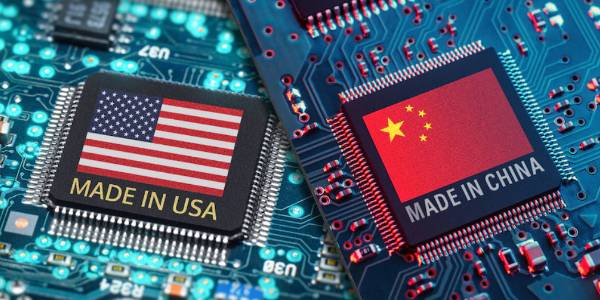
We’re not giving you chips anymore
On August 26, the United States imposed semiconductor export controls.
They target chips that are highly useful for developing AI technologies (essential for machine learning).
Specifically, Washington introduced an export licensing regime for Nvidia and AMD graphics cards.
And now, you’re not even allowed to make them
On October 7, the U.S. expanded controls on transactions involving items used for semiconductor manufacturing.
The August measures were about withholding chips themselves, but this time Washington is also obstructing manufacturing.
"BIS is also informing the public that specific activities of “U.S. persons” that ‘support’ the “development” or “production” of certain ICs in the PRC require a license."
“In addition, our Bureau of Industry and Security (BIS) is notifying the public that certain activities by U.S. persons that support the development or production of specific integrated circuits (ICs) in the People’s Republic of China (PRC) will require a license.”
The rules explicitly call out China.
They state that U.S. persons who help with development or production will need a license,
and that 28 companies located in China will face a broader range of items that require authorization for production.
In response, China’s Naura Technology Group has halted development work involving its U.S. employees.
This is not retaliation; it is simply compliance with the rules.
So far, China has been more acquiescent to the controls than many expected.
So what exactly are the Export Administration Regulations (EAR)?
The Export Administration Regulations (EAR) are a regime designed to prevent the leakage of sensitive technologies,
and they primarily target dual-use items—goods that can also be used for military purposes.
Why is Washington imposing, and now tightening, these controls?
Given that China accounts for 24% of global semiconductor demand, it is hard to imagine that U.S. companies will emerge unscathed.
According to the text of the EAR, China is rapidly developing exascale computing capabilities and using them for military purposes such as weapons design and testing,
and the document frames these measures as national security controls aimed at the military domain.
*Exascale computing: a computing system capable of performing at least 10¹⁸ IEEE 754 double-precision floating-point operations per second
"Potential international rivals in the AI market are creating pressure for the United States to compete for innovative military AI applications. China is a leading competitor in this regard ... "
“Potential international rivals in the AI market are putting pressure on the United States to compete in developing innovative military AI applications. China, which is at the forefront of this market, is …”
The Congressional Research Service (CRS) in the U.S. Congress
has published reports arguing that China’s lead in AI is putting pressure on the United States, and that Washington must move quickly to develop AI for military use.
In my view, this is essentially a technology embargo justified under the banner of military security.
The EAR has long been used to restrict dual-use items, and semiconductors happen to be militarily relevant, which provides a convenient rationale.
Fundamentally, this is about slowing China’s move up the value chain.
Defending the chip crown: What semiconductors mean to the U.S. and China
Over the past three decades, semiconductors have been one of the key engines of U.S. economic growth. On the back of this rapid expansion, American firms now account for 49.3% of global semiconductor revenue.
Fully aware of how critical chips are, Washington has repeatedly sanctioned other countries to protect its own “honey pot” of semiconductor profits.
Historically, the U.S. has:
blocked the Soviet Union from copying U.S. semiconductor technology after World War II through export controls,
and when Japan’s chip industry began to dominate the market in the mid-1980s, it used ex officio investigations to impose steep tariffs and force a bilateral agreement.
*Ex officio investigation: A powerful trade remedy under which the U.S. Department of Commerce can, on its own initiative and without industry petitions, investigate dumping by a specific country’s exports and impose high tariffs.
Today, America’s honey pot is being rapidly encroached upon by China.
In the integrated circuit (IC) market, China’s output grew from 142.4 billion yuan in 2010 to 884.8 billion yuan in 2020, a compound annual growth rate (CAGR) of 20.24%—3.75 percentage points higher than the global average.
In terms of overall market size, China’s share is expanding quickly,
but its imports are still enormous, meaning its self-sufficiency in ICs remains low relative to its market share. (IC imports totaled 350 billion dollars in 2020.)
Beijing is acutely aware of this and has long poured resources into boosting its self-sufficiency,
and its market share in semiconductor fabrication as well as assembly, packaging, and testing has been on the rise.
According to the Semiconductor Equipment and Materials International (SEMI),
China plans to build 31 IC fabrication plants, or fabs, by 2024—more than double the 12 fabs planned in the United States.
Yet even if it catches up in manufacturing capacity, one thing remains lacking: cutting-edge technology.
China has largely caught up in producing mid- to low-end chips used in smartphones and automobiles, but when it comes to advanced technologies such as AI and high-end modeling, it still lags behind.
And the very frontier technology at issue in the new controls is exascale computing.
Put simply, it means “extremely, extremely fast computing speed.”
With exascale computing, you can run countless simulations, which makes it applicable to cybersecurity, chemical management and research, food production, medicine, and many other fields.
Because of its blistering processing power, you can iterate simulations over and over again.
For technologies like AI and machine learning, exascale computing is indispensable.
Seen in this light, Washington’s strategy starts to make sense.
Technologies that shape our world are advancing at breakneck speed,
and exascale computing sits at the first gateway to a vast array of applications—many of which do not even exist yet.
Naturally, it is also a key enabler of military power.
Xi Jinping has been championing the Mao-inspired doctrine of “common prosperity,” known in Korean as gongbu-ron.
Under this vision of “everyone living well together,” Beijing has set its policy goals
around high value-added industries that can raise aggregate income, while using domestic tools such as subsidies and tax adjustments to boost purchasing power.
One reason China has long favored real estate is that it naturally incorporates credit (loans), making it an easy way to bulk up the economy.
But recently, China has been badly burned by its property sector.
China had been relying on real estate to prop up domestic demand, and that once-speeding train has now ground to a halt.
This makes semiconductor technology, which can generate substantial value added, all the more crucial for Beijing.
Will we see another flare-up in the trade war?
This raises another question.
“If semiconductors are this vital to China, why hasn’t Beijing hit back harder?”
Chips are a capability China simply must secure, and the U.S. is tightening controls precisely to block that effort.
Doesn’t this set the stage for another round of U.S.-China trade conflict?
To answer that, I revisited the backdrop to the last major trade war and how it unfolded.
That conflict was rooted in the protectionism that Donald Trump had advocated even before he became president.
After Trump took office, mounting concerns over China’s alleged technology theft led Washington to slap an additional 25% tariff on Chinese goods, kicking off the trade war.
*Protectionism: The practice of imposing high tariffs on imports to shield specific domestic industries.
China retaliated, and the two countries traded blows with tariffs, halted crude oil imports, restricted transactions, and even labeled each other currency manipulators.
In essence, their retaliatory measures were a trial of strength, with each side putting its own economic power on the line.
At the time, the Congressional Budget Office projected that, following the onset of the trade war, U.S. real consumption, investment, and GDP would all decline, while inflation would rise.
Global investment also fell sharply as uncertainty spiked.
Today’s macro backdrop—uncertainty, interest rates, and exchange rates—looks very different from 2018.
Both sides understand that tit-for-tat escalation over these controls would be dangerous.
Three-line summary:
1. Officially, U.S. semiconductor controls on China are about military security, but in practice they function as technology sanctions.
2. China is rapidly gaining share in chip manufacturing and assembly, but still lacks advanced technology; what Washington is really trying to block is the outflow of U.S. know-how.
3. Semiconductors are crucial to China’s growth strategy, but given current economic conditions, Beijing faces real constraints in mounting a forceful response to U.S. controls.
Newsletter
Be the first to get news about original content, newsletters, and special events.
Continue reading

Note By Ryunsu
The Intelligence Layer of Financial Infrastructure
Ryunsu Sung

Aware Original
Why Bitcoin Keeps Falling: The Downward Spiral of the Gamma Trap
Ryunsu Sung

Aware Original
The Overwhelming Autonomous Driving Leader Proven by Numbers: Waymo’s Full-Scale Takeoff
Ryunsu Sung

Aware Original
The Precarious State of ‘American Exceptionalism’ and a Shaken Dollar Hegemony
Ryunsu Sung