Oct 21, 2022
Microsoft: Becoming the Complete Package
Ryunsu Sung
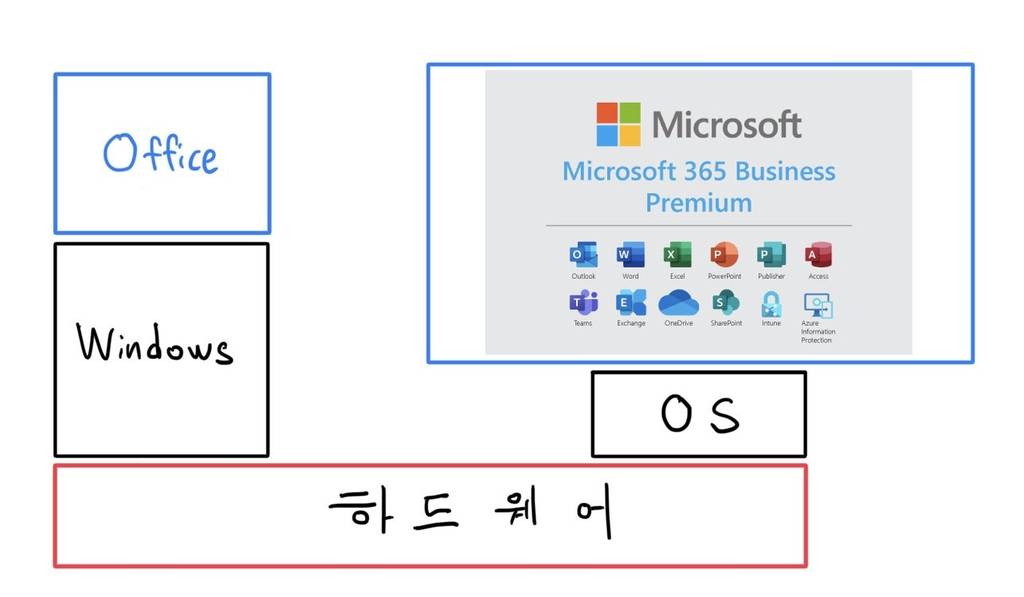
Microsoft (MSFT) is changing the name of its bundled productivity suite of Word, Excel, PowerPoint and other work apps from Office 365 to Microsoft 365.
The brand that, for decades, cemented the rule that office work meant using the Office suite installed on a Windows PC is disappearing in an instant.
There are several reasons Microsoft is abandoning such a well-established brand and pushing a new one, but at the core is the company’s shift from a software “product”-based business to a “services”-based one.
And this shift is the result of rigorously reshaping the business around customer needs.
The way I come at it, Ben, is that I like to separate out, “What is the system, what are the apps”? Of course, we want to bring the two things together where we can create magic, but at the same time, I also want our application experiences in particular to be available on all platforms, that’s very central to how our strategy is.
For example, when I think about the Metaverse, the first thing I think about is it’s not going to be born in isolation from everything else that’s in our lives, which is you’re going to have a Mac or a Windows PC, you’re going to have an iOS or an Android phone, and maybe you’ll have a headset. So if that is your life, how do we bring, especially Microsoft 365, all of the relationships that are set up, the work artifacts I’ve set up all to life in that ecosystem of devices? That’s at least how I come to it and that’s where when Mark started talking to us about his next generation stuff around Quest was pretty exciting, so it made a lot of sense for us to bring — whether it’s Teams with its immersive meetings experience to Quest or whether it’s even Windows 365 streaming, and then, of course, all our management and security and even Xbox — [to Quest]; that’s what is the motivation behind it.
In an interview with Ben Thompson, Microsoft CEO Satya Nadella explained the decision to bring Microsoft Teams to Meta’s (META) newly launched VR headset, the Meta Quest Pro, by saying that “you have to think about the system and the applications separately.” He added that while Microsoft would love to control both where it can and create “magic,” it is strategically critical that its applications be available on every platform.
He also showed a very down-to-earth view of the metaverse: the point is that the metaverse will not be a world completely cut off from our existing lives.
People will keep using Windows or Mac computers, and they will keep using phones running iOS or Android. On top of that, they may own a VR headset. If that describes your life, Microsoft has every incentive to deliver its applications and services in the metaverse you experience through that headset—for example, Microsoft 365, Windows streaming, and Xbox cloud gaming.
Before Microsoft fully entered the cloud market, the company’s business was dominated by two product lines: the Windows operating system and the Office productivity applications. Windows is an operating system (OS) for PCs, and the Office apps were products that (properly) ran only on Windows. Because most companies used Microsoft Office for documents, spreadsheets, and presentations, anyone who wanted to do productive work was effectively forced to install Windows as well. Windows and Office together became an extraordinarily successful cash cow for Microsoft.
But as times changed, problems emerged. The PC market went through a massive shift with the arrival of the iPhone. People who had done most of their computing on desktop PCs or laptops began replacing more and more of those tasks with the computer in their pocket. Outside of work hours, the need for Windows dropped sharply. As a result, revenue from selling Windows and Office started to decline. Feeling the urgency to adapt, Microsoft replaced its CEO with Satya Nadella and, following Amazon (AMZN), made a full-scale push into the cloud market.
What emerged from that effort is the ecosystem shown on the right. People care about what they can actually do with their computing devices, not which OS they are running. In fact, because of software compatibility issues, the OS itself often becomes the obstacle. As Microsoft leaned into the cloud business, it migrated all of its applications and services to the cloud and attached the “365” branding to its products—signaling that they are available anytime, anywhere, 365 days a year.
This transformation has allowed people to do much more with Microsoft’s products and services, and in the cloud environment, Teams has taken over the role that Windows once played as the hub that brings Microsoft apps together.
When he introduced Microsoft 365, Satya Nadella also shared the following view on the operating system:
Sometimes I think the new OS is not going to start from the hardware, because the classic OS definition, that Tanenbaum, one of the guys who wrote the book on Operating Systems that I read when I went to school was: “It does two things, it abstracts hardware, and it creates an app model”. Right now the abstraction of hardware has to start by abstracting all of the hardware in your life, so the notion that this is one device is interesting and important, it doesn’t mean the kernel that boots your device just goes away, it still exists, but the point of real relevance I think in our lives is “hey, what’s that abstraction of all the hardware in my life that I use?” – some of it is shared, some of it is personal. And then, what’s the app model for it? How do I write an experience that transcends all of that hardware? And that’s really what our pursuit of Microsoft 365 is all about.
I no longer think a new OS will start from the hardware. When I was in college, Tanenbaum, who wrote a book on operating systems, described it this way: “It does two things. It abstracts the hardware, and it creates an application model.” Today, hardware abstraction has to start from all the hardware in your life. That’s why the idea that one single device is what matters has lost relevance. Of course, that doesn’t mean the kernel that actually boots your device disappears—it’s still there. But the truly important question is, “Hey, how do all the pieces of hardware I use get brought together and abstracted?” Some of that hardware is for work, some of it is personal. So what should the application model look like? How do we build an experience that spans all of that hardware? That is exactly what Microsoft 365 is pursuing.
For Satya Nadella to say, in effect, “The OS no longer matters; what matters is the experience we deliver to users” would have been unthinkable back when Microsoft generated substantial revenue from selling Windows. That is how fundamentally the company’s business structure has changed compared with ten years ago.
As you can see from Microsoft’s second-quarter earnings report, cloud and related services already account for the largest share of revenue. Windows OS has been folded into a segment called “More Personal Computing,” making it clear that it is no longer the company’s core business.
At a Microsoft event three years ago, Satya Nadella said, “What we want to do with the launch of the Microsoft 365 brand is to build user-centric experiences. Users will form relationships with other users, and together they will create many things across a variety of devices.”
And at a recent event, he described Microsoft 365 this way:
With Microsoft 365 we provide a complete cloud-first experience that makes work better for today’s digitally connected and distributed workforce. Customers can save more than 60% compared to a patchwork of solutions. Microsoft 365 includes Teams plus the apps you always relied on — Word, Excel, Powerpoint, and Outlook — as well as new applications for creation and expression like Loop, Clipchamp, Stream, and Designer, and it’s all built on the Microsoft graph, which makes available to you the information about people, their relationships, all their work artifacts, meetings, events, documents, in one interconnected system. Thanks to the graph you can understand how work is changing and how your digitally distributed workforce is working. This is so critical, and it all comes alive in the new Microsoft 365 application.
Through Microsoft 365, we deliver a cloud-first experience that improves the work environment for today’s digitally connected and distributed workforce. Compared with cobbling together competing solutions, customers can cut costs by around 60%. Microsoft 365 includes Teams and the work apps you’ve always relied on—Word, Excel, PowerPoint, and Outlook—plus creative tools like Loop, Clipchamp, Stream, and Designer. All of this runs on Microsoft Graph. Thanks to Graph, you can see information about the people you collaborate with, their relationships, work artifacts, meetings, events, and documents in a single, interconnected system. Graph lets you understand how work is changing and how your digitally distributed workforce is actually working. This is critically important, and Microsoft 365 brings it to life.
In the end, Microsoft has redesigned its legacy products around the expectations of its customers and users, and has completed a user-centric work experience. The end of the Office brand is a signal that Microsoft’s long-running efforts have finally borne fruit.
Newsletter
Be the first to get news about original content, newsletters, and special events.
Continue reading

Note By Ryunsu
The Intelligence Layer of Financial Infrastructure
Ryunsu Sung

Aware Original
Why Bitcoin Keeps Falling: The Downward Spiral of the Gamma Trap
Ryunsu Sung

Aware Original
The Overwhelming Autonomous Driving Leader Proven by Numbers: Waymo’s Full-Scale Takeoff
Ryunsu Sung

Aware Original
The Precarious State of ‘American Exceptionalism’ and a Shaken Dollar Hegemony
Ryunsu Sung