Nov 23, 2022
Climate Goals in Reverse: Creating a Fund Is Not Progress
Sungwoo Bae
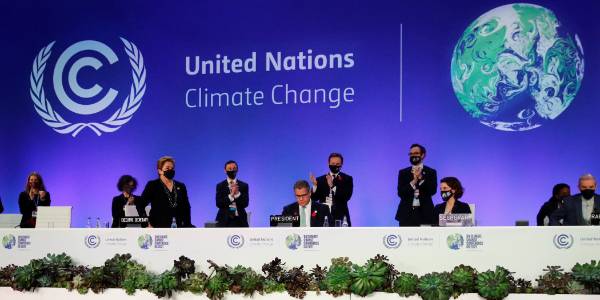
“We have determined a way forward on a decades-long conversation on funding for loss and damage – deliberating over how we address the impacts on communities whose lives and livelihoods have been ruined by the very worst impacts of climate change.”
-Simon Stiell, UN Secretary-General
At the tail end of COP271, held in Sharm el-Sheikh from November 6 to 19 (extended by one day beyond the scheduled period),
the international community reached agreement on “establishing a fund to respond to loss and damage in developing countries caused by climate change.”
COP27'1: 27th Conference of the Parties to the UN Framework Convention on Climate Change (UNFCCC)
As of the 7th, proceedings were not going smoothly, with 9 of the world’s top 10 greenhouse gas–emitting countries absent and no progress on discussions about phasing out fossil fuels,
but the creation of this fund was reported as “developed countries acknowledging that climate change caused by them has inflicted damage on developing countries.”
In other words, the very act of setting up the fund is seen as meaningful in itself.
To judge anything properly, you first need to understand what it actually contains.
First, here are the key agreements from the previous conference, COP26.
- Phased reduction of fossil-fuel-based power generation
- Review of the target to limit global temperature rise (1.5°C by 2030)
- Doubling of developed countries’ climate finance (by 2025)
It’s actually very easy to grasp.
Gradually reduce fossil fuels, check whether we are managing energy use for the planet,
and increase the amount of climate finance directed to areas such as clean energy.
The discussions that followed at COP27 were as follows.
- Phasing down fossil fuels
The United States and European countries called on China and India to halt their use of fossil fuels.
Predictably, China and India opposed this, and the outcome was once again a "phasing down" of fossil fuels, as before.
There was also a proposal to include not only coal but also oil and natural gas in the fossil fuel phase-down, but this too failed to pass due to opposition from Russia and Saudi Arabia.
In the end, it merely amounted to maintaining current levels of use.
- Limiting global warming to 1.5°C
Capping global warming at 1.5°C is the most desirable scenario scientists have put forward in response to climate change.
The idea is to set 1.5°C as the upper limit for temperature rise, and it was first formalized at COP21.
China and India, however, argued that this target lacks scientific feasibility and sought to water down the existing agreement.
- Recapitalizing multilateral development banks
Previously agreed environmental funding commitments have not been well implemented.
That is because implementing projects to mitigate and adapt to climate change requires astronomical sums of money that grow over time.
Around one trillion dollars a year is needed from various countries, investors, and multilateral development banks, but few are eager to step up, since this is framed as "support."
Accordingly, there is now a possibility that the capital of multilateral development banks will be adjusted (recapitalized) to provide support to developing countries.
- Loss and damage fund for developing countries
The request is based on the fact that most greenhouse gases are emitted by developed countries, while the damage is borne by developing countries.
Developing countries argued that they need funding to adapt and respond to these environmental changes,
but developed countries responded that they were in a difficult position, citing the recent state of the global economy.
Here’s an interesting angle to watch.
Under the UN’s criteria for developing countries, China and India are also classified as developing countries.
If a fund is created to support developing countries because they are harmed by greenhouse gas emissions from developed countries,
it effectively means that China would receive money from other developed countries because China is suffering damage from greenhouse gases emitted by China itself.
This chart is a map that classifies countries by their level of development,
with blue indicating advanced economies, yellow developing countries, and red least developed countries.
You can clearly see that China and India are classified as developing countries.
Despite China and India’s very high levels of carbon emissions,
under the UN’s classification, which factors in not only gross national income (GNI) but also the Human Assets Index (HAI),
and the Economic and Environmental Vulnerability Index (EVI), they have not yet made it into the ranks of advanced economies—hence this situation.
On top of that, disagreements over the exact wording used to describe the fund extended COP27 beyond its original closing date of the 18th to the 19th.
Developing countries urged negotiators to use the term “compensation” instead of “responding to loss and damage.”
They argued that damage from droughts, floods, and rising sea levels stems from development in advanced economies, and that they therefore need funding to adapt and respond to these impacts,
Even if you spend money to install solar panels in the name of driving change, it is meaningless to people who have suffered flood damage.
Human Capital Index2: The total amount of human capital (healthcare and education) that a child born today can expect to accumulate by age 18
Economic and Environmental Vulnerability Index3: An index designed to represent the relative severity of a country’s economic and environmental challenges
But of course, that was never going to be enough.
Developed countries refused to use the word “compensation,” and in the end they settled on the term “response,” which merely acknowledges that they bear responsibility for the planet.
Backsliding on climate goals
In 2009, developed countries such as the United States and Europe pledged to provide “100 billion dollars a year in support,” but that commitment has not been fulfilled.
At this year’s conference, the pledge itself even came close to being deleted.
This is why media outlets are hailing the mere fact that “a fund was agreed to be established” as a major step forward.
However, looking at the overall outcome, COP27 represents a significant step backward compared with COP26.
Because negotiations over the fund did not progress smoothly, talks on other agenda items failed to produce concrete agreements.
Countries put their national interests first, with some declaring they would never agree unless certain conditions were met, and others declining to participate in matters they saw as unrelated to themselves.
No provisions were adopted to regulate the use of fossil fuels, nor were there any new rules to curb greenhouse gas emissions.
In that sense, COP27 can probably be summed up in a single sentence.
In the final agreement, low-emissions energy was in fact included.
Low-emissions energy here effectively means natural gas.
It can also be read as a green light to freely expand natural gas development.
Among the countries with large gas reserves, many are both developing economies and those already suffering from floods, droughts, and rising sea levels.
Turkmenistan, Iran, African nations such as Mozambique, Nigeria, Venezuela, Algeria—the list is long.
It may actually be harder to find a country that is not taking a hit.
In a world that still needs gas, we also have to bear in mind that capital could end up flowing primarily to these very countries.
Three-line summary:
1. COP27 (the 27th UN Climate Change Conference of the Parties) was held from November 6 to 19.
2. A dramatic agreement was reached to establish a fund to address loss and damage in developing countries, which some media outlets hailed as a major step forward.
3. In reality, almost nothing concrete was decided, and in some respects the outcome even represents a step backward.
Newsletter
Be the first to get news about original content, newsletters, and special events.
Continue reading

Note By Ryunsu
The Intelligence Layer of Financial Infrastructure
Ryunsu Sung

Aware Original
Why Bitcoin Keeps Falling: The Downward Spiral of the Gamma Trap
Ryunsu Sung

Aware Original
The Overwhelming Autonomous Driving Leader Proven by Numbers: Waymo’s Full-Scale Takeoff
Ryunsu Sung

Aware Original
The Precarious State of ‘American Exceptionalism’ and a Shaken Dollar Hegemony
Ryunsu Sung